miércoles, mayo 19, 2010

Cesc Fabregas exit to force Wenger rethink


Cesc Fabregas, more than any other player, personifies the philosophy Arsene Wenger has been so determined to instil at Arsenal. But having told his mentor that he no longer subscribes to the view that success is imminent for the club, his likely departure to Barcelona must result in a strategic rethink for his manager.
Cesc Fabregas and Gerard Pique
GettyImages
Cesc Fabregas and Gerard Pique were team-mates as children
It is Wenger's firm contention that recruiting a player at such a young age - as he did in 2003 when audaciously plucking a 16-year-old Fabregas from the Barcelona academy - breeds commitment to the club and a deep-rooted affinity with the style of football demanded by the manager. He explained last season: "When we go for young players, it is to get them to love the club, love to be together and love to achieve together. A team sport is about that. It is about achieving something together in a positive human atmosphere."
Given the financial restrictions imposed by the move from Highbury to Emirates Stadium, it is an approach that was not only laudable - especially in opposition to what Wenger has termed Chelsea's "financial doping" since 2003 - but also necessary. It is no small achievement that when working with a tight budget, Wenger has delivered Champions League football year on year.
But for a player like Fabregas, mere qualification is not enough, not when his hometown club are winning six trophies in 2009 alone. It appears his "love" for Arsenal has waned, and the flirtation period with Barca has begun. It is an attraction he cannot resist.
Not when he has the chance to play under the man he idolised as a child, Pep Guardiola. Not when he has the chance to play alongside his former colleagues at La Masia, Lionel Messi and Gerard Pique. Not when Barcelona, the club of his heart, are playing the finest football on the globe, and winning a succession of trophies. Who could blame him for wanting to join a team making history?
For Arsenal, impressive wins over the likes of Milan, Villarreal and Porto have proved false dawns in recent years, but Wenger has always been at pains to claim that success is just a season away, that his young players are close to fulfilling their potential. For a player as talented as Fabregas, though, tomorrow will not do.
While Wenger transformed him into an exceptional talent, providing the Catalan with the perfect environment in which to develop and entrusting him with responsibilities out of all proportion with his experience - first when allowing him to marshal the midfield as a teenager, and secondly when handing him the captaincy at the age of 21 - in the end, he could not convince Fabregas that trophies were around the corner.
A lack of investment in star names - Andrei Arshavin aside - is believed to have preyed on Fabregas' mind and Wenger's reluctance to spend is a stick with which certain sections of the support will beat the manager enthusiastically if the captain does indeed return home.
Of course, Barcelona have maintained that Arsenal will have the final say and that they will "respect" the club's wishes. But it looks for all the world as though Fabregas, after seven years at Arsenal, has decided that he cannot wait any longer to see if investment is forthcoming, if trophies are not just a possibility, but a probability, as they are at Camp Nou.
It is to Wenger's ultimate credit that Fabregas is the player he is today. But the departure of the midfielder, if it happens, could fatally undermine the approach that Wenger has fostered in recent seasons. What chance does it have of succeeding if the greatest fruit of Wenger's labour leaves at just 23?
Other notable beneficiaries of the policy remain of course - Nicklas Bendtner, Gael Clichy and Alex Song prominent among them - but Fabregas is the leader, the example that helps Arsenal sell their youth policy to talented teenagers across the globe. Come to Arsenal, they undoubtedly say, and you get the chance to play, the trust of a manager who places his faith in youth. But five barren years mean they can no longer promise trophies.
Cesc Fabregas
GettyImages Will Cesc Fabregas be joining a vastly talented Barcelona side?
The departure of Fabregas, if confirmed, must force a rethink in Wenger's policy. Funds must be invested, experienced players purchased, particularly given the financial situation has eased considerably this year.
The loss of the physical manifestation of Wenger's approach to the game would undercut everything the manager has tried to achieve. It has been a praiseworthy attempt to replicate the success of the Ajax academy products of the early 1970s. But while laudable, the exit of Fabregas would demonstrate it to be flawed.
The ultimate irony for Wenger is that Fabregas will be joining a club where the Frenchman's values are perfectly expressed. Fabregas could be lining up next season alongside Victor Valdes, Gerard Pique, Carles Puyol, Sergio Busquets, Andres Iniesta, Xavi, Pedro, Bojan and Lionel Messi - all acolytes of the club's youth system and exponents of beautiful football.
Barcelona just do it better. Why play for Barcelona lite when you can represent the real thing? That is the question Fabregas has asked, and why he has chosen to leave Arsenal this summer.
Wenger must now question whether a fresh approach of his own is required.

Copyright ©2010 ESPN Internet Ventures. Terms of Use and Privacy Policy and Safety Information/Your California Privacy Rights are applicable to you. All rights reserved.


martes, mayo 18, 2010

What is the aftermath of the American open-wheel civil war 15 years after it truly started between the upstart IRL and CART? NASCAR is the only winner.

Honor, blood and a brewing battle


Hinton By Ed Hinton ESPN.com
Editor's note: ESPN.com senior writer Ed Hinton has spent more than 35 years covering motorsports across the globe for entities including Sports Illustrated, The National Sports Daily, Tribune Newspapers and the Atlanta Journal-Constitution. This four-part series, The Damage Done, is his memoir of what he saw and reported leading up to the American open-wheel civil war and the consequences it wrought.
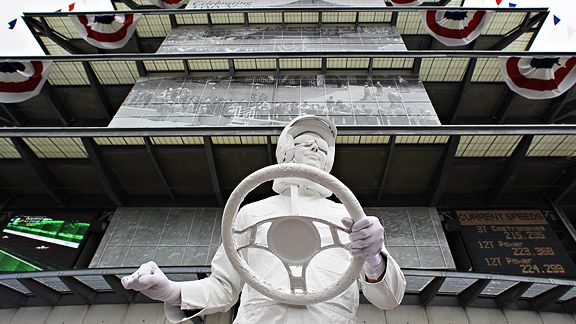
Motor Speedway Pagoda 
AP Photo/Darron Cummings 

Indianapolis Motor Speedway and its famed pagoda will see a massive crowd for the 94th running of the Indianapolis 500 on May 30. But the ghost of decisions past -- and a withering battle for control of the sport -- casts a pall over the event now.
On the afternoon of July 3, 1995, I was faxed a preview of a document that amounted to the Kansas-Nebraska Act of major open-wheel racing in the United States. It was sure to lead to civil war.
But unlike the American Civil War, both sides would be devastated, and neither side would recover.
From this one document would ensue 13 years of mutual destruction between two leagues, sending the Indianapolis 500 plummeting from the pinnacle of all the world's motor racing, and eroding Indy car racing to second class in the American public mind.
There they languish today, two years into the aftermath of the war, going into the 94th Indy 500, the 15th one since the split.
That fateful fax was preceded by a phone call from an anxious-sounding Bob Walters, then chief publicist at Indianapolis Motor Speedway.
"I want to run something by you," he said. "We've prepared a press release, and I want to hear your thoughts before we send it out to the rest of the media."
Why me? Probably it was where I worked at the time, and maybe experience. I was a senior writer at Sports Illustrated, then the most influential sports publication in the U.S., if not the world. I was the auto racing specialist, having covered all forms of the sport for more than 20 years.
Even before the fax cleared the machine, the impact was clear: If this edict were carried out, the destruction of Indy car racing would be a matter of time.
The release stated that beginning with the 1996 Indianapolis 500, 25 of the traditional 33 starting spots would be reserved for teams from the new Indy Racing League.
This was astounding because the IRL had yet to turn a wheel on a racetrack, and had yet to demonstrate that it could even attract 25 cars.
This was a blatant surprise attack on the powerful Championship Auto Racing Teams Inc. (CART), which since 1979 had accounted for most of each Indy 500 field. Now, if these teams complied, they would have to come on their knees with upwards of 40 cars to compete among themselves for only eight starting positions in the 500.
And this was revolutionary: The edict would shatter Indy's most inviolable tradition -- that "the fastest 33 cars start the race," no matter where in the world they came from.
The intent of the "25 and 8 rule," as it would come to be called in notoriety, was to force CART teams to compete not just at Indy but in all races of the new IRL, if they were to gather enough points to get Indy 500 reservations.
Outside Indy in May, CART owned the rest of the year with its own series, which was the most lucrative ever developed for open-wheel cars in the U.S.
Clearly, CART would never stand for the new rule. The glamorous teams would stay away from Indy entirely. Then inevitably would come the terrible test of who could do without whom: CART without the cornerstone race, or the Indy 500 without CART and its supporting series of races.
I phoned Walters back immediately with my opinion: This would be taken by CART, and by the motorsports media nationwide, as nothing short of a declaration of war.
This would rip open-wheel racing asunder, just when there was enough trouble maintaining prestige and popularity with one series.
But Indy car racing was in denial about the growing threat from another form of racing, rising rapidly out of the South and spreading nationwide, into mainstream popularity: NASCAR.
Walters listened, then sighed. "Well," he said, with a resigned tone in his voice, "Tony wants to go with it."

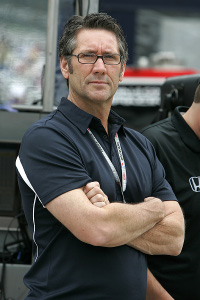
Anton Hulman "Tony" George had ascended the throne of Indianapolis Motor Speedway by hereditary right in 1990, at age 30.
Tony George
AP Photo/Darron CummingsTony George took the helm of Indianapolis Motors Speedway at age 30.
He was the only male heir to his grandfather, Anton Hulman, who had saved the Speedway and the 500 after World War II.
Tony George arrived with a plan for sweeping change, and a chip on his shoulder. Indy had run too long on tradition, he decreed, and henceforth it would be run as a business.
I liked that. And I liked him -- still do, even now that he has fallen almost completely out of auto racing, his 20 years of bold plans no less noble for their terrible failures.
What had passed as tradition at Indy had seemed to be largely stodginess to me. But with young George in charge, the air seemed fresher and the grounds brighter every time you drove through one of the tunnels into the infield. He was making large-scale physical changes, fast.
And he was plunging into new business that would bring far more racing to Indy than just the 500.
He had begun hosting NASCAR races in 1994 -- even though traditionalists deemed it heresy -- and the first two Brickyard 400s had been landslide sellouts.
He had entered into a transoceanic flirtation with the treacherous, ruthless realm of Formula One and its czar, Bernie Ecclestone, with an eye toward bringing a U.S. Grand Prix to Indy.
So, going into the declaration of war in '95, Tony George had been a bullet train of change in motor racing.
Except for that chip on his shoulder.

Throughout the years of Indy car civil war, many would believe it was all about money through control of the sport. I thought that was true on the CART side, but never on George's side.
His motive, I still believe, was mainly a matter of family honor and noblesse oblige toward open-wheel racing.
As a teenager he had followed his grandfather around Gasoline Alley, meeting the tough and towering figures of Indy's golden era: A.J. Foyt, Parnelli Jones, Bobby and Al Unser, Johnny Rutherford, Lloyd Ruby … Americans all.
Then the late 1970s brought a series of annually occurring tragedies into the young life of George.
On the night of the 1976 Indy 500, when Tony was 16, his father, Elmer George -- a former driver married to Tony Hulman's only child, Mari -- was shot and killed in an argument with a trainer at the family's horse farm outside Terre Haute, Ind.
When Tony was 17, his grandfather died, and even the hallowed Speedway itself seemed somehow orphaned without its gentlemanly owner/dictator, known throughout motor racing simply as "Mr. Hulman."
When Tony was 18, in 1978, former Formula One and Indy driver Dan Gurney circulated a letter to other progressive team owners. It proposed that America's premier open-wheel series, then controlled by the United States Auto Club (USAC), could and should be much bigger, better and richer than just a satellite tour to the cornerstone Indianapolis 500.
USAC was essentially a puppet of the Speedway, and rejected Gurney's proposals. So in late '78 he and other owners, such as Roger Penske and U.E. "Pat" Patrick, formed CART, and soon gathered most of the top teams into their alliance.
The glaring exception was the irascible, indomitable Foyt, the most independent-minded man in motor racing, coming off his unprecedented fourth Indy 500 win in '77 -- and fiercely loyal to the Hulman-George family and USAC.
When Tony was 19, in 1979, CART lawyers hand-delivered entries for 44 cars, right on deadline for that year's 500, to the Speedway. The entries were accompanied by demands for what it would take for that huge, vital group of cars and drivers to show up.
Then the CART teams set off to inaugurate their own series, with two races prior to the Indy 500, and await the Speedway's response.
They got it that April. As they unloaded in the garages of what was then called Atlanta International Raceway for their second race as an organization, there erupted something of a commotion among them, and I began asking them what was the matter.
They had received a telegram telling them they were not welcome at the Indy 500 that year, they said. Almost immediately they began discussing litigation. They would go to court for the right to compete in the 500. They would succeed.
From there, they effectively seized control of Indy, even though technically USAC remained the sanctioning body for the 500. What the CART teams wanted at the Brickyard, the CART teams usually got.
Quickly the USAC "championship trail" of other races died out, displaced by the CART series. CART owners unabashedly tried to emulate Formula One, with emphasis on road courses and street circuits in addition to oval tracks.
The street circuits especially made business sense, because events could be held in and near major cities by simply laying out temporary courses, rather than building permanent racetracks.
But road and street racing also meant a different kind of driver. The tough Americans, who'd come up to Indy off the heartland oval dirt tracks, were phased out, displaced by Europeans, South Americans and Australians who'd been trained from childhood as road racers.
Slowly, American fans grew apathetic toward the imported personalities, and yearned for a resurgence of the Foyt ilk. But the Americans would never return in significant enough numbers.
So, arguably, the downfall of Indy car racing began with CART's shift to road racing.
Tony George had to witness and stomach all this. But he was an heir in waiting. Not until he was 30, by family tradition, would he be given command.
Meanwhile he apprenticed in racing from the ground up, starting out as a fuel man on the pit crew of his idol and in some ways surrogate father, Foyt.
Independent as Foyt was, he had always deferred to the Hulman-George family, and worshiped them. From the outset, he acknowledged to young Tony just how important they were.
Foyt, left with no alternative, eventually participated in CART, but never cottoned to it. He longed for the USAC days when he reigned supreme at Indy, before the uppity barons in their Gucci loafers seized control in 1979.

From early on at the helm of Indy, George was chronically at odds with the barons of CART -- Penske, Gurney, Patrick, and by the '90s Chip Ganassi, Barry Green, and most of all, the militant Carl Haas and his even more militant business partner, actor Paul Newman.
The barons treated young George more as a new force to be felt out and somehow dealt with. Word was, they considered him a punk.
Publicly they treated him, as Haas would later put it, as "a track promoter," just one of many -- even though George's track was unchallenged as the greatest in the world.
They granted George a seat on the CART board of directors, but only as a non-voting member. They thwarted his every suggestion at every turn through the early '90s, saying no when he proposed an engine formula compatible with Formula One's, saying no when he proposed a neutral Indy car czar such as the roundly respected Leo Mehl, then Goodyear's director of worldwide racing.
George wanted to achieve what not even his grandfather had. He wanted to make Indy -- which previously had stood in splendid isolation -- a full-fledged, and certainly prominent, member of the worldwide racing community.
The CART barons continued to vote for what was best for their own series -- and their own individual business interests.
Finally, thoroughly exasperated, George walked out of a CART meeting, resigned from the board, and began working on a plan for his own racing series.
Traditionalist racers and fans had always resented CART as something of an occupying force on the hallowed ground of Indy, usurpers, dripping with opulence and arrogance and racing more for profit than passion.
In addition to importing road racers, CART teams had adopted the European tradition of drivers "buying rides" -- that is, bringing lucrative sponsorships or enormous personal wealth with them.
That added yet a second padlocked gate to keep out young Americans raised on the dirt tracks.
"We went on our knees to the CART teams," Jeff Gordon's stepfather, John Bickford, told me as Gordon rose to stardom in NASCAR.

Jeff  Gordon They basically said, 'Show us the money and we'll show you the seat.'
-- Jeff Gordon
"They basically said, 'Show us the money and we'll show you the seat,'" Gordon would tell me later.
So George had to watch helplessly, with mixed emotions, while Gordon, the kid who'd grown up as a sprint-car prodigy in nearby Pittsboro, Ind., won the inaugural Brickyard 400 -- a NASCAR race.
Even then, George was watching yet another local prodigy tearing up the dirt tracks in USAC midgets, sprint cars and Silver Crown cars, winning in everything he drove -- but with no hope of buying a CART ride.
That was Tony Stewart of nearby Columbus, Ind.
Enough was enough.
Somehow, George determined, he would reopen the path to Indy for the likes of Gordon and Stewart. In 1994 he announced the founding of the Indy Racing League, with Stewart as his poster boy.
At every turn, old-liners whispered encouragement into George's ear. His was a glorious cause, making Indy again the showplace for American talent risen from the Saturday-night tracks.
He meant to accomplish this in part by simplifying technology and lowering costs, so that teams wouldn't need drivers who could bring money, and could afford to hire drivers who brought only their sheer ability.
Not the least of the old-liners, constantly in George's ear, was Foyt himself.
"Tony's a brilliant boy, and so's his mama," Foyt told me in one of his classic malapropisms, as the winds of Indy war began to blow.
Foyt would abide by -- and indeed influence -- every move the Hulman-George family made in breaking free of CART.
Many, including me, failed to take the IRL seriously enough when it was announced in '94. I thought it was mainly a bargaining ploy by George, to bring CART back to its senses from extravagance.
"The IRL will never turn a wheel in competition," I assured European journalist friends who were familiar with CART due to its international expansion, and concerned about a possible devastation of Indy car racing and the greatest single race in the world.
But as I read and reread the fax of July 3, 1995, and realized the magnitude of the "25 and 8" edict, I felt about as prescient as the North Carolina politician who in 1861 had dismissed the imminent conflict as so minor that he would "wipe up every drop of blood shed … with a handkerchief …"
Buzz CalkinsAP Photo/Chris O'Meara 
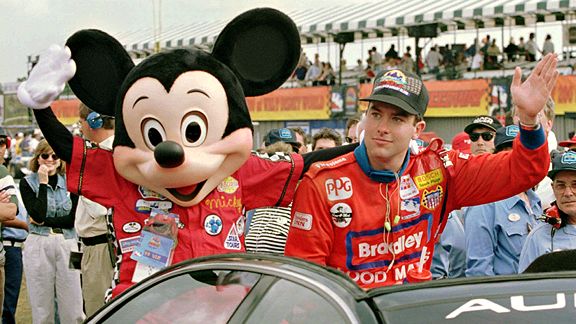
Buzz Calkins took a victory lap with Mickey Mouse after the inaugural IRL race in 1996. The question 14 years later remains what exactly was there to celebrate, then and now.
The Fort Sumter of the Indy car civil war was, of all places, Walt Disney World near Orlando, Fla.
The first shots were fired by the IRL, in holding its first race on Jan. 27, 1996, on a hastily constructed, three-cornered track built by Indy engineers on Disney property.
All the previous fall, there had been hope that Indy and CART would somehow reconcile -- as they had after various bickering over the previous 17 years -- and that perhaps George would even rescind the "25-8" rule for the Indy 500.
But now, a walk through the paddock at the Disney track made the gravity of the situation clear.
Conspicuous by their absence were the affluent CART teams with their posh entertainment tents, luxury motor coaches and glitzy paint schemes for lucrative corporate sponsorships.
They'd kept their vow not to give in to George's attempt to force them to compete in IRL races -- even though at this point in the technical transition, mere tweaks to the CART cars would have made them IRL-legal.
Instead, here were the upstart IRL teams, fielding mostly second-hand CART cars, or old cars from the independent owners who annually fielded teams on a "one-off" basis, for the Indy 500 only.
Tony Stewart had arrived as poster boy and was filling his role magnificently, telling any journalist who asked that there was no way he ever could have gotten a ride in CART. The IRL, with its open arms to American dirt-trackers, was a career-changer for him.
Walking among the patchwork teams in the paddock, Gordon Kirby of the British magazine Autosport asked me, "What strikes you as starkly different?"
"Pretty ragtag," I said. But there was something more profound.
"No sponsorship logos," Kirby said. And he was right. There were hardly any.
Where were they getting the money to compete? Word was already spreading that George was subsidizing teams out of his own pocket, or at least the Indianapolis Motor Speedway coffers.
This was a radical departure from any other racing league's financial model, ever. For just this one race, you could understand: Leagues and tracks often paid "appearance money" to top teams and drivers just to show up, so their names could be used in ticket promotions.
But a full season? If you'd driven the 55 miles up to Daytona Beach and proposed to NASCAR czar Bill France Jr. that he subsidize the Cup teams for a season, he'd have laughed you out of his office.
The sanctioning body provided the forum, the tracks provided the prize money, and other than that, the teams were on their own. That was the NASCAR model.
Then again, not even the France family could match the vast family wealth of the Hulman-George family, and its Hulman & Co., founded as a wholesale grocery company by Tony George's great-great-grandfather, Herman Hulman, in 1879. Now the company was broadly diversified, not only with ownership of Indianapolis Motor Speedway but with holdings ranging from Clabber Girl baking powder to television stations and the Telex communications company.
Oh, and there was one more enormous contributor to George's war chest: NASCAR itself.

Both NASCAR and Formula One had taken public positions of neutrality in the coming Indy car war, but it was no secret that the other two giants didn't care much for CART.
F1 had fought CART's international expansion in the early '90s and had no love for the bellicose American barons who'd pushed into Australia, Canada and Europe, with designs on Japan -- all traditionally F1 turf.
But NASCAR's interest was closer and more fundamental. Organizations such as CART, in which team owners pushed the sanctioning body and track promoters around, were anathema to NASCAR's ruling France family.
When NASCAR's founder, "Big Bill" France Sr., summoned the various kingpins of stock-car racing from around the nation to Daytona Beach in 1947, he knew he had to seize absolute control of the new league. An adviser had warned him that this would work only as a dictatorship -- that a governing board would be disastrous.
And fear of any sort of union was fresh in France's mind as he formed NASCAR -- in May 1947, Anton Hulman had put down a bitter drivers' strike at the Indianapolis 500.
Now, in the mid '90s, there was undercurrent talk in the NASCAR garages that a CART-like organization of powerful team owners might arise, to take advantage of an upheaval in track ownership and demand higher purses.
Standing under umbrellas in the rain at Talladega one weekend, in an otherwise deserted garage area, one powerful team owner had posed an intriguing question to me privately.
"How much would you pay for NASCAR right now?" he asked, amid rumors that giant corporations such as Rupert Murdoch's NewsCorp, or even Disney, might be interested in buying.
"You mean if I were Murdoch? Oh, $2 billion, $3 billion, I don't know," I said.
"Now then," and here the owner pointed to the haulers of NASCAR's top six or seven teams, "if those rigs were suddenly gone, those teams were out, how much would you pay for NASCAR?"
"Oh," I mused, "about $1.99."
"Exactly," he said, and walked away in the rain.
The point was, without its major teams and stars, NASCAR would be worthless. This came precariously close to the thinking that had started CART.
Bill France Sr and Jr
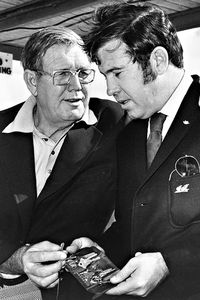
AP PhotoBill France Sr., left, turned started NASCAR and took full control of the sport. His son Bill France Jr., right, would eventually maintain that control, expand the sport nationwide and fend off several uprisings against the family leadership.
What had started the NASCAR rumblings, in parallel to the Indy car conflict, were the activities of O. Bruton Smith. A longtime France family rival, Smith was chairman of Speedway Motorsports Inc., a track conglomerate he'd taken to Wall Street as a publicly traded company on the New York Stock Exchange.
The France family, which owned NASCAR outright and controlled International Speedway Corp., another track conglomerate, was watching Smith closely as he gobbled up tracks with built-in NASCAR race dates. He already owned the tracks at Charlotte and Atlanta, bought existing tracks such as Las Vegas and Bristol, and planned to build new ones, his crown jewel-in-progress being Texas Motor Speedway.
Smith was acquiring tracks so fast, and had disagreed with the Frances so much for so long over how NASCAR should be run, that there was much conjecture that he might start a rival stock-car series.
Then Smith, not yet able to get a Cup race scheduled for his yet-to-open Texas track, hinted that he might just run a non-sanctioned or "outlaw" race, after the NASCAR season was over, with an enormous purse.
That got the attention of the NASCAR owners, and that in turn fueled rumblings of a CART-type council of team owners to sell their services to the highest-bidding series.
Amidst all this, Bill France Jr., second czar in the NASCAR dynasty, publicly postured himself as neutral in the Indy car conflict.

NASCAR's funding of Tony George's war chest was indirect, in the form of the enormous revenues Indy took in from the new, but firmly established, NASCAR race there, the Brickyard 400.
George would tell me years later that there was "no question" this additional bonanza from his NASCAR race emboldened and bolstered him for the IRL venture.
There was another connection with NASCAR: John Cooper, a longtime friend and sometimes business associate of the France family, and onetime NASCAR marketing director, was now one of George's closest advisers.
After working for NASCAR in the '70s, Cooper in late 1979 had been named president of Indianapolis Motor Speedway in something of a quiet move, and served until 1982. Then, in the early '90s, Cooper had helped facilitate the partnership of Indy and NASCAR for the Brickyard 400.
On Jan. 26, 1996, the eve of the first Indy Racing League event, the IRL threw a lavish cocktail party in a tent outside the new track on the Disney property.
I noticed Cooper standing to the side, taking it all in. I walked over to check out some rumors I'd heard.
"Hey, John, you know what I hear? I hear the CART barons were scrambling to settle this thing, and that Tony was listening," I said.
"That right?" he asked.
"Yeah. And then I heard you to told Tony, 'f--- 'em,'" I said. "And that was it."
Cooper demurred, smiled, contemplated the ice cubes in his vodka and soda, then took a sip.
"Well," he said, "I might have said something along those lines."

Coming Thursday: Part II of The Damage Done: Getting It Wrong

Ed Hinton is a senior writer for ESPN.com. He can be reached at edward.t.hinton@espn.com.

©2010 ESPN Internet Ventures. Terms of Use and Privacy Policy and Safety Information/Your California Privacy Rights are applicable to you. All rights reserved.


Las 36 contrataciones fallidas de Nacional en los últimos diez años

Arriba de izquierda a derecha: Jhon Charria, Baiano, Andrés  Mosquera y Juan Carlos Mariño. Abajo de izquierda a derecha: William  Zapata, Francisco Arrué, Fernando Martel y Armando Carillo.
Arriba de izquierda a derecha: Jhon Charria, Baiano, Andrés Mosquera y Juan Carlos Mariño. Abajo de izquierda a derecha: William Zapata, Francisco Arrué, Fernando Martel y Armando Carillo. FUTBOLRED


Desde 2001, la O. Ardila Lulle ha gastado millones de dólares en contrataciones de jugadores para el cuadro 'verde'. Futbolred cita 26 colombianos y diez extranjeros que pasaron sin pena y sin gloria.
En Nacional la constante es que lleguen los jugadores por buenos y salgan por malos. La dirigencia nacionalista gasta y gasta dinero para contratar los mejores elementos de los equipos colombianos. Sin embargo, cuando estos se ponen la camiseta verde y blanca, otra es la historia. Pocos rinden y la mayoría fracasa.
"Sabemos que no podemos equivocarnos más en las contrataciones. Por eso tenemos una comisión técnica que evalúa los fichajes antes de gestionar la contratación", apuntó el presidente De la Cuesta, explicando el mecanismo utilizado ahora para no volver a fallar en la traída de jugadores.
Futbolred, consultando a varios hinchas 'verdolagas', seleccionó 36 contrataciones fallidas de Atlético Nacional desde 2001. Esta es la no deseable lista:
1. Iván Velásquez: la 'Champeta' deslumbró en Deportes Tolima por su capacidad para resolver en el área y por sus fuertes remates. Implicó un alto precio para Nacional que lo fichó en 2001. Pero Velásquez no fue la figura que todos esperaban. En 2003 el hilo se rompió y el delantero cartagenero regresó con una mano adelante y la otra atrás a su club de origen.
2. Rafael Castillo: prospecto y figura del Deportivo Pereira. Jugador habilidoso, rápido y con una feroz pegada. Nacional desembolsó un buen monto para traerlo pero 'Rafa' no dio pie con bola. No mostró su faceta de desequilibrio y el 'verde' una vez más perdió su inversión. Castillo partió a mitad de 2003 a Bucaramanga.
3. Avimiled Rivas: El medio campista tuvo un sonoro paso por Deportes Quindío en 2002. Con el aval de Alexis García, la dirigencia lo contrató. Pero su fichaje para Real Sociedad anticipó su salida del club. Pocos lo recuerdan porque su nombre no figuró.
4. Felipe Benalcázar: estuvo un año en el 'verde' entre 2002 y 2003. El lateral valluno no aportó en ataque las cualidades que mostró en el Deportivo Pereira. Salió por la puerta de atrás y pasó a Bucaramanga continuando su carrera de trotamundos.
5. Javier Arizala: El lateral izquierdo solo estuvo un semestre en el conjunto paisa. Su rendimiento no fue óptimo y no pudo reeditar las buenas presentaciones que tuvo con Deportes Quindío. Llegó y se fue en silencio.
6. Camilo Giraldo: precedido de una estelar presentación en Envigado, el volante reforzó a Nacional en 2003. Se le recuerda un gol agónico en la Copa Suramericana ante Deportivo Quito que clasificó al 'verde' a los cuartos de final. Pero no fue regular en su nivel y por eso salió al final del año.
7. Óscar Restrepo: el 'Chico' fue una de las grandes decepciones de la final del torneo Apertura entre América y Nacional en 2002. No pudo echarse el equipo al hombro y terminó pagando los platos rotos. El subcampeonato de la Copa Suramericana de 2002 fue su mayor logro aunque no tuvo mucha figuración en el equipo que dirigía Alexis García.
8. Hilario Cuenú: Después de tres años con Independiente Santa Fe, el defensor zaguero tulueño pasó a reforzar al conjunto 'verde' en 2003. Solamente estuvo seis meses porque su nivel no fue el esperado.
9. Néstor Salazar: tuvo dos etapas. Primero en 2001 cuando llegó proveniente de América y en 2004 cuando fue goleador de Centauros de Villavicencio. Pero en ninguno de los ciclos tuvo el potencial que mostró en los otros equipos que jugó. En su segundo periodos apenas duró seis meses. El alto costo que generó no fue bien recompensado.
10. Leonardo Mina Polo: solo estuvo seis meses vistiendo la camisa verde y blanca después de haber sido repatriado de Colón de Santa Fe. Poco ofreció y por eso solo se quedó para el Apertura 2003.
11. Rubén Bustos: tuvo un corto paso por el conjunto paisa en 2004. No figuró. Poco jugó y terminó su estadía en el 'verde' sin recordación alguna. Sus buenos remates de larga distancia y su buena pegada no estuvieron presentes en Nacional. Retornó a América en 2005
12. Leonardo Fabio Moreno: fue transferido en junio de 2005 de San Lorenzo de Almagro a Nacional. Pero estaba pasado de kilos y su juego no fue el mejor. Poco jugó y cuando lo hizo no fue ni la sombra del delantero habilidoso que fue goleador con América de México en 2000. Pronto salió y regresó al fútbol mexicano.
13. William Zapata: el volante de marca valluno estuvo en el 'verde' entre 2006 y 2007. No tuvo espacio en la titular y vio pocas veces la posibilidad de actuar. Pocos recuerdos dejó en el equipo y se fue al Cúcuta en silencio.
14. Giovanni García: el 'Chaza' fue debut y despedida en el cuadro verdolaga. Engrosó la lista de laterales en julio de 2006 pero no jugó y estuvo en el banco de suplentes durante los seis meses que vivió en Medellín. A finales del año partió sin haber desempacado las maletas todavía.
15. Óscar Passo: defensor central y lateral de excelente pegada en los cobros de tiro libre. Cuando estaba en Deportes Tolima fue convocado a la Selección Colombia y su carrera tenía alta proyección. Pero llegó a Nacional y nada pasó. Poco o nada hizo y se la pasó lesionado. Tuvo más de un año de para por una lesión de cadera y eso se prdoujo su traspaso a Real Cartagena.
16. Breiner Castillo: 'Brecas' estuvo entre 2005 y 2006 y solo fue suplente. Primero de Andrés Saldarriaga y después de David Ospina que no dio oportunidad hasta que partió al fútbol francés en 2008. En el 'verde' no pudo mostrar sus buenas atajadas que hoy lo destacan en Deportes Tolima.
17. Vladimir Marín: el buen mediocampista antioqueño no tuvo gran figuración en Nacional. Militó en el 'verde' en 2006 y tuvo un par de partidos buenos en Copa Libertadores donde le marcó a Cerro porteño. Pero su transitar no fue el esperado y a finales de ese año, emigró al Libertad paraguayo
18. Gerardo Bedoya: el 'General' jugó 29 partidos con Nacional entre 2005 y 2006 y anotó cuatro goles. Al final del Apertura 2006, fue separado de la concentración antes de un partido por la liga local y su contrato finalizado. Los motivos nunca salieron a luz pública. Al parecer, las decisiones vinieron desde las altas esferas. Por lo que representó para el fútbol colombiano en la primera parte de la década, decepcionó en con la camiseta verde y blanca.
19. Elkin Murillo: el buen volante de la Liga de Quito no fue el mismo cuando se vistió de verde en 2007. Lució desacompasado y ansioso. Fue defendido por el técnico Quintabani que ya lo había dirigido en Cali pero la relación con la hinchada se rompió y terminó marcando su salida a mediados de 2008.
20. Wálter Moreno: el campeonato con Cúcuta Deportivo en 2006, la semifinal de la Libertadores en 2007 y la actuación con la Selección en dos partidos eliminatorios con Jorge Luís Pinto, atrajeron a la directiva verdolaga que lo contrató para reemplazar el vacío que dejó el ecuatoriano Iván Hurtado. Pero la historia no se repitió y Moreno es hoy el cuarto central de Atlético Nacional.
21. Jhon Charria: Nacional pagó más de 500 mil dólares por el creativo del Deportes Tolima. Firmó por tres años pero sus constantes lesiones y su bajo nivel, terminaron la relación en apenas seis meses. Fue prestado a Pereira a principios de 2009 y ahora milita con baja figuración en Deportivo Cali.
22. Carlos Rentería: el hermano de Wason llegó antecedido de un palmarés de goleador con Atlético Huila. Pero en Nacional no tuvo continuidad y jugó poco. Con la anuencia de Cabrero retornó al equipo 'opita' tras la muerte de Hernán Córdoba y es recordado por el gol que le marcó al 'verde' en Neiva. Fue prestado a Equidad en modalidad de canje por Víctor Giraldo y de nuevo le marcó a Nacional en la penúltima fecha del Apertura 2010.
23. Armando Carrillo: seis meses y ningún gol. Tuvo varias lesiones y nunca pudo afianzarse en la titular en el Finalización 2009. Ramón Cabrero poco lo utilizó y antes de finalizar el préstamo a un año, retornó a su club de origen, Deportivo Cali.
25. Andrés Mosquera: defensor central proveniente del descendido Deportivo Pasto. Jugó apenas siete partidos y se lesionó de gravedad en el juego ante Huila. Ahora se recupera de una rotura del ligamento cruzado anterior de la rodilla izquierda que lo incapacita por los siguientes seis meses.
26. Carlos Pérez: El 'Enfermero' llegó a engrosar la línea de porteros del 'verde' tras la lesión de Eduardo Blandón y la partida de Carlos Barahona a Tuluá. Sin embargo, solo ha tenido figuración en el banco de suplentes. El ex Junior y Bucaramanga tiene contrato hasta el 31 de diciembre.
El top 10 de extranjeros:
1. Leonardo Fernández: el arquero boliviano llegó como refuerzo en 2005. Jugó solamente ocho partidos y perdió la titularidad con Andrés Saldarriaga que terminó como arquero campeón. Se fue con prontitud a Tiro Federal y dejó un mal recuerdo.
2. Luciano Vera: el 'Calavera' Vera fue un defensor paraguayo que jugó en el 'verde' entre 2005 y 2006. Llegó como refuerzo para la zaga tras la partida de Aquivaldo Mosquera. Aunque anotó goles y fue titular en Copa Libertadores, no marcó diferencia y salió a mediados de 2006.
3. José Manuel Rey: el zaguero venezolano, recio y fuerte, solo estuvo en Nacional un semestre por sus reiteradas convocatorias a la Selección de país. Eso terminó la relación con la dirigencia y anticipó su salida. En 16 partidos disputados anotó tres goles en 2006.
4. Adriano Gerlin Da Silva: fue traído en 2006 por haber sido balón de oro en el Mundial Sub. 17 de 1991 y el Mundial Sub.20 de 1993. Pero fue uno de los grandes errores de los directivos verdolagas porque Adriano venía de una larga inactividad. No jugó y solo estuvo los meses finales de 2006.
5. Fernando Martel: el media punta chileno de corta estatura, llegó como refuerzo para el Finalización 2007 tras la partida de Jairo Patiño. Jugó varios partidos y alcanzó a festejar el bicampeonato. Pero como extranjero, no marcó diferencia y por eso empacó su maleta cuando Quintabani, el que lo trajo, salió de Nacional.
6. Francisco Arrué: chileno. Fue el extranjero más reprochado antes de Baiano. Llegó como creativo para suplir la falencia en el medio campo cuando Aldo Ramírez fue vendido a Morelia. Fue un fiasco. No mostró nada y solo en seis meses partió por la puerta de atrás. Fue la contratación que más se le criticó a Víctor Marulanda.
7. Carlos Villagra: el delantero paraguayo jugó en 2008 con el 'verde' y reforzó el ataque en la Copa Libertadores. Fue cuota de Quintabani con quien había salido campeón con Pasto en 2006 pero en Nacional no dio pie con bola. Hasta el equipo intentó cambiar la estrategia e implementar el juego aéreo pero esa tan poco fue la solución. Regreso con su país a jugar con Cerro Porteño.
8. Juan Carlos Mariño: otro de los estruendosos fracasos de la dirigencia nacionalista. El creativo peruano se sumó al 'verde' a principios de 2009 como "repuesto inflado" cuando Aldo Ramírez retornara a Morelia a mitad de año. Pero sus constantes lesiones y su baja producción, anticiparon su salida.
9. Dermival Almeida Lima 'Baiano': el lateral brasileño, ex Boca Juniors, fue una desilusión más. Nunca estuvo en forma y no rindió como defensor ni como volante. Además le pegó muy mal a la pelota quieta, una de sus 'virtudes'. Fue silbado y chiflado por los hinchas que adelantaron su salida de la titular y del equipo en diciembre pasado.
10. Marcos Mondaini: aunque ha mostrado avances en el último mes, el delantero argentino no fue solución para el faltante en ataque de Atlético Nacional. Mondaini fue suplente en 2009 con Nacional de Uruguay y tenía un largo periodo de inactividad. Por eso le costó adaptarse al 'verde'. Suma tres tantos en la Copa Postobón pero no es garantía de gol en el equipo de la Liga.

Juan Diego Ortiz Jiménez
Corresponsal Futbolred.com
Medellín 


COPYRIGHT © 2010 CEET Prohibida su reproducción parcial, así como su traducción a cualquier idioma sin autorización escrita de su titula. Ver Términos y Condiciones 


viernes, mayo 14, 2010

"Hay que decirle sí a un Nuevo América", sentenció Jorge Iván Ospina

Los jugadores del América siguen desesperados con la situación  económica del club.
Los jugadores del América siguen desesperados con la situación económica del club.JAVIER AGUDELO/CEET

El alcalde de Cali visitó a los jugadores y cuerpo técnico para oficializarles la aprobación de la minuta por parte de Coldeportes para la creación de la nueva institución.
La práctica de fútbol en Cascajal tuvo la participación del burgomaestre Jorge Iván Ospina quien pisó la sede luego de las 5 de la tarde y no fue precisamente para ponerse los cortos, pero sí para dar un avance en el proyecto Nuevo América S.A. Ospina se reunió con cuerpo técnico y jugadores para oficializar: "El día martes a las 10 de la mañana donde acompañados por 'la marea roja' (hinchas) saldremos desde el CAM, hasta la Cámara y Comercio, y la notaria para registrar el Nuevo América".
La aprobación de la minuta por parte de Coldeportes era el aval que requería el Alcalde para continuar con el proceso de democratización propuesto para salvar a los 'Diablos Rojos', aunque fue vehemente: "La decisión dependerá de los aportantes en la asamblea el próximo viernes, porque yo no puedo obligarlos a tomar la decisión de qué hacer con el equipo".
El alcalde insistió en que: "Hay que decirle sí a un Nuevo América con accionistas de carne y hueso que puedan dar la cara y con una posibilidad mayúscula de sacar adelante el equipo, donde los nuevos y viejos aportantes pasarán por un filtro para unirse al proceso".
El proyecto ha vivido innumerables obstáculos para llegar a la realidad, pero al poner una fecha para el registro de la nueva institución, la responsabilidad queda del lado de los aportantes que deberán asumir su real compromiso con América, marcando el futuro del club.
"Sí la decisión de la asamblea es ceder los activos y los pasivos a la Nueva América de Cali, seguiremos adelante con este nuevo proyecto futbolero, pero sí ellos deciden otra vía de sanear y capitalizar el equipo seremos respetuosos de su decisión", manifestó Ospina.
América vive su crisis más profunda de la historia y pareciera que el único salvavidas es el lanzado por la alcaldía, no obstante el primer mandatario del municipio aclaró: "Yo no puedo forzarlos a tomar una decisión, estamos llegando al final de nuestra participación porque lo demás dependerá de ellos, además se acaba el tiempo y se deben tomar determinaciones fundamentales".
El sueño de los hinchas y seguidores de los 'escarlatas' es no ver morir a su equipo, así, la asamblea del 21 de mayo se convierte en trascendental para la reconstrucción el equipo, porque sí no se escoge el camino de la democratización, los aportantes deberán proponer otra solución inmediatamente, para capitalizar el equipo.
Por su parte los jugadores recibieron con regocijo la visita del alcalde que se ha 'puesto' la camiseta y ha dado la cara, algo que hace rato no ven los profesionales de sus actuales administradores.
Finalmente Ospina explicó la cooperación del Municipio en la parte final del proceso: "La alcaldía tendrá participación en la creación de Nueva América S.A. Pero luego de conformada tendrá una junta que se encargará de manejar el equipo como corresponde". 

Steven López Niño
Corresponsal Futbolred.com
Cali

COPYRIGHT © 2010 CEET Prohibida su reproducción parcial, así como su traducción a cualquier idioma sin autorización escrita de su titular. Ver Términos y Condiciones


jueves, mayo 13, 2010

Arsenal boss Arsene Wenger targets defensive signings

Arsenal manager Arsene Wenger has confirmed he intends to strengthen his defence this summer after a fifth season in a row without silverware.

Arsenal boss Arsene Wenger
Wenger says Arsenal have been average in defence this year
 
"Going forward we have done very well but defensively we have been average," said Wenger.
"When you concede 40 goals you don't win the title. I want to rectify that.
"My transfer policy this summer will be to keep our strengths going forward, add one player, and add more defensive strength to our team."
The Gunners rounded off their Premier League campaign with a 4-0 win over Fulham on Sunday and pipped rivals Tottenham to third place.
But failure in both of the domestic cup competitions and a Champions League exit at the hands of Barcelona this year means Arsenal have now gone five seasons without winning a trophy.
Centre-half Thomas Vermaelen has been a revelation since his move from Ajax last year but lapses have cost the team as their title push faded towards the end of the campaign.
And Fulham's Brede Hangeland and Senegal defender Pape Diakhate are thought to be on Wenger's radar as he looks to shore up his shaky rearguard, although William Gallas could be on his way out of the club.
Gallas, 32, and fellow centre-backs Sol Campbell and Mikael Silvestre are all out of contract in June and Gunners chairman Peter Hill-Wood described Gallas's demands for a new contract as "quite extravagant".
"I don't think we are prepared to go along with it. We would very much like him to stay but I think for one year - and not on the money he wants," added Hill-Wood.
"He is a good player but you have got to draw the line somewhere.
"If he can get the money somewhere else, good luck to him. We still hope he will sign but if he doesn't, he doesn't."
Campbell, who will be 36 in September, returned to his old club during January on a short-term deal and impressed after stepping in to bolster an injury-hit rearguard.
Wenger is keen to keep the former England captain - who led Arsenal through their unbeaten campaign of 2003/2004 - to bring some much-needed experience and Campbell sees no reason why he should not be at the Emirates Stadium next season.
"I fancy staying, of course I do," Campbell told the club's official website. "I want to stay and I want to give it my all for at least another year. I could do two but the manager never gives out two.
"Give me one year and I will work every day and try to win a trophy and bring some kind of glory back to Arsenal.
"We will sit down, it has started, and we will try to thrash something out.
"The negotiations are either going to be done in a week or two or it might take until July - you just don't know how things will pan out.
"We will have to see how Arsene sees me at the club." 

BBC © MMX


Dorlan Pabón será el primer refuerzo de Nacional para el Finalización

El delantero Dorlan Pabón será uno de los refuerzos del equipo  'verde' para el torneo Finalización 2010.
El delantero Dorlan Pabón será uno de los refuerzos del equipo 'verde' para el torneo Finalización 2010. Archivo CEET

"Estoy feliz", dijo el jugador de 22 años que presentará, el próximo martes, los exámenes médicos y firmará el contrato. El delantero es el primero de las contrataciones que pidió el técnico Santa.

Envigado y el onceno 'verde' firmaron un preacuerdo por la transferencia del 75 por ciento de los derechos deportivos.

El cuadro verdolaga dejó el camino allanado para contratar su primer refuerzo de cara al segundo semestre. El presidente Juan Carlos de la Cuesta firmó con su par de Envigado, Juan Pablo Upegui, un preacuerdo para la transfrencia de Dorlan Pabón.

El contrato incluye la compra del 75 por ciento de los derechos deportivos y la totalidad de los derechos federativos. El jugador finalizará su participación con Envigado el domingo y el próximo martes presentará los exámenes médicos para llenar la hoja de requisitos.

"Gracias a Dios se me están dando las cosas por un futuro para mi familia y para mí. Estoy feliz", indicó Pabón.

Los coqueteos de Nacional hacia Dorlan se concretaron por fin. Desde hace un año, cuando Víctor Marulanda era el presidente, el 'verde' fue a la carga por el volante de 22 años pero la forma de pago y el monto no convencieron a Envigado. Su paso quedó en suspenso y se le dio prioridad a ofertas del extranjero.

Hace un par de meses, un grupo de empresarios que lidera Fernando Hidalgo -el mismo que representa a la Bruja Verón- estuvo cerca de comprar el 80 por ciento de los derechos económicos de Pabón y de ubicarlo en Racing de Avellaneda. Sin embargo no aportaron los avales bancarios y la negociación se cayó.

El año pasado Pabón también estuvo cerca de emigrar al fútbol francés, específicamente al Le Mans, pero nuevamente los soportes de los pagos no se dieron y su salida al exterior se convirtió en una larga novela.

Hoy es una realidad. El martes Pabón irá a las oficinas de Nacional para presentar los evaluaciones físicas y médicas. Después de superar todos los controles subirá al segundo piso de la sede administrativa del club y estampará su firma como nuevo jugador de Atlético Nacional.

Pabón, que mide 1.70 metros, inició su carrera en 2006 en el desaparecido Bajo Cauca en el que permaneció hasta 2007 cuando lo fichó Envigado. En 101 partidos disputados en su carrera deportiva, anotó 24 tantos.

Juan Diego Ortiz Jiménez
Corresponsal Futbolred.com
Medellín

COPYRIGHT © 2010 CEET Prohibida su reproducción parcial, así como su traducción a cualquier idioma sin autorización escrita de su titula. Ver Términos y Condiciones


miércoles, mayo 12, 2010

Agresión de Victor Valdés a Mourinho


Indianapolis 500 primer before 33 IndyCar Series drivers chase the biggest prize in racing at the Brickyard

Mmm good: Indy 500 and alphabet soup


Oreovicz By John Oreovicz ESPN.com

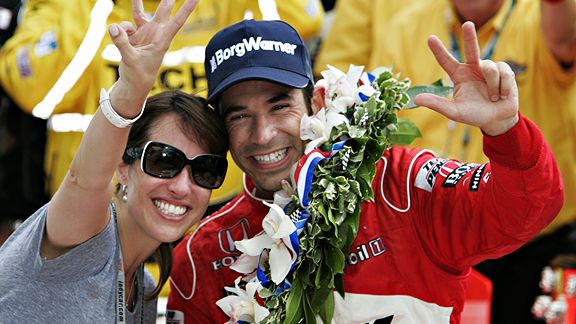
Helio Castroneves 
AP Photo/Michael ConroyHelio Castroneves and his sister, Katiucia, celebrate Indianapolis 500 win No. 3 on May 24, 2009.

INDIANAPOLIS -- It's the second week of May and the natives are getting restless.
With prerace track time cut by a third from Indianapolis 500 tradition, cars still haven't taken to the track at Indianapolis Motor Speedway. When the engines finally do fire on Saturday for Opening Day, there is likely to be more of a sense of urgency and excitement in the lead-up to Qualifying Weekend (May 22-23).
Traditionalists are horrified at the revisions to the qualifying format, which will lock in 24 of the 33 starters on the first day, including a nine-driver shootout over the course of the final 90 minutes of Pole Day. All in all, it's an effort to create excitement and value. Bump Day could prove to be entertaining this year as well, given an increase in participation over recent years.
What won't change is the fact that 33 cars will line up on the final Sunday of the month to chase the biggest prize in racing over 200 laps at the Brickyard. Here's an A-to-Z primer over what to look for in the buildup to the 94th running of the Indianapolis 500:
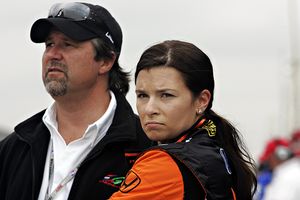
Danica Patrick
AP Photo/Tom StrattmanMichael Andretti's driver stable features IndyCar's most popular driver: Danica Patrick.
A is for Andretti Autosport, which is fielding five cars in this year's Indianapolis 500. A also is for American, and Michael Andretti's team features four of them -- son Marco Andretti, Danica Patrick, Ryan Hunter-ReayJohn Andretti, who is making a rare IndyCar appearance. and 47-year-old cousin
B is for Bump Day, which has the potential for excitement with at least 38 entries vying for 33 starting positions. It's also for Briscoe -- Team Penske driver Ryan Briscoe says that winning Indy is his No. 1 goal in 2010.
C is for the condensed format of the month of May. Three practice days and two days of qualifications have been slashed from the schedule; the two-week format should help cut costs for teams and could restore some excitement and urgency to the proceedings.
D is for Dixon and Dario. Target Chip Ganassi Racing has the strongest driver lineup in the IndyCar Series. Scott Dixon and Dario Franchitti have won the past three series championships and two of the past three Indianapolis 500s.
E is for the 100 percent fuel grade ethanol that powers every Indy car.
F is for the five female drivers who will attempt to qualify at Indy -- Danica Patrick, Simona de Silvestro, Sarah Fisher, Ana Beatriz and Milka Duno.
G is for GoDaddy Girl Danica. She's still the top draw in the IndyCar Series and she always excels at Indianapolis, where she finished third in 2009.
H is for Helio Castroneves. The popular Brazilian is not only the defending Indy 500 champion; he gets his first crack at joining the select group of four-time winners that includes only Rick Mears, Al Unser and A.J. Foyt. H also is for Honda, which will again provide bulletproof V-8 power to every car in the field.
I is for the ICONIC committee, which will work behind the scenes during the month of May to determine the future IndyCar engine and chassis formula. It's also for Izod, which you may have noticed is spending some advertising dollars to promote the series.
J is for the J-stand at the exit of Turn 4 of the IMS oval. It might just be the best seat in the house for both the oval and the road course used for Moto GP racing.
K is for Kanaan. 2004 IndyCar Series Tony Kanaan led every year at Indianapolis between 2002 and 2008 (a total of 214 laps) but has never won IndyCar racing's biggest event.
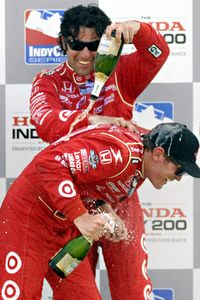
Franchitti/Dixon
AP Photo/Tom E. PuskarTarget Chip Ganassi Racing is the envy of the garage with defending champ Dario Franchitti, top, and Scott Dixon steering the ship.
L is for leadership. Both the Indianapolis Motor Speedway and the Indy Racing League feature new faces at the top compared to a year ago, before Tony George stepped down from both roles. Jeff Belskus is the new CEO at IMS and Randy Bernard has taken the reins at the IRL.
M is for Milka Duno, the driver most likely to fail to qualify (or crash trying) for this year's race.
N is for the kind of nasty comments the other drivers often have about Milka Duno's driving.
O is for oval racing. Though road races outnumber ovals on the IndyCar schedule, Indy is still the outright king in terms of prestige and payout. The winner will take home more than $3 million.
P is for Power -- Australian Will Power, who won the first two races of the season and jumped out to a healthy points lead during the opening road racing swing. He finished fifth at Indy in 2009 in his first crack at the race in Team Penske equipment. P also is for Paul Tracy, who will team with former boss Barry Green at KV Racing to avenge their disputed second-place finish in 2002.
Q is for qualifications, which will be a bit different this year. Though the field will line up as always in 11 rows of three, there will be only two qualifying days. Twenty-four cars can lock in on Pole Day, and the fastest nine will engage in a late-afternoon shootout.
R is for Randy Bernard, the new Indy Racing League CEO who has put a spur into IndyCar racing in his first two months on the job.
S is for Sarah Fisher and Simona de Silvestro. The other female drivers in the race might garner more attention for the things they do and say off the track, but Sarah and Simona are all about the business of racing.
T is for tires, which are supplied to the field by Firestone and are almost never a concern in IndyCar racing.
U is for under construction. Which is the state that most of the highways on the west side of Indianapolis are in this month. Plan your route carefully and allow extra time to get to the Speedway.
V is for Vitor Meira, who returns to Indianapolis in A.J. Foyt's car a year after breaking his back during the 500. It's also for Vision Racing as Tony George's team makes its first race of the season with driver Ed Carpenter.
W is for weepers, a longtime IMS nemesis. A high water table canceled a recent IndyCar test at Kentucky Speedway, and drying the track is always a tedious process.
X is the occasional rating for the party scene in the Turn 3 infield on race day. The Snakepit is gone but certainly not forgotten by these race-day revelers.
Y is for yellow flag. With passing at a premium, luck of the draw with yellows and pit stop strategy is critical in determining the winner of the 500. Since 2003 the race has averaged eight caution periods totaling 53 laps.
Z is for ZZ Top, the headliner of the annual Carb Day concert. Carb Day has emerged as the best party day of the month, and having the Best Little Band in Texas perform won't hurt that reputation.
John Oreovicz covers open-wheel racing for ESPN.com.

©2010 ESPN Internet Ventures. Terms of Use and Privacy Policy and Safety Information/Your California Privacy Rights are applicable to you. All rights reserved.